
Folklore / Song and memory
The Peacock Princess
A beloved Tai Lue narrative of love and separation, preserved through voices, manuscripts and temple painting.
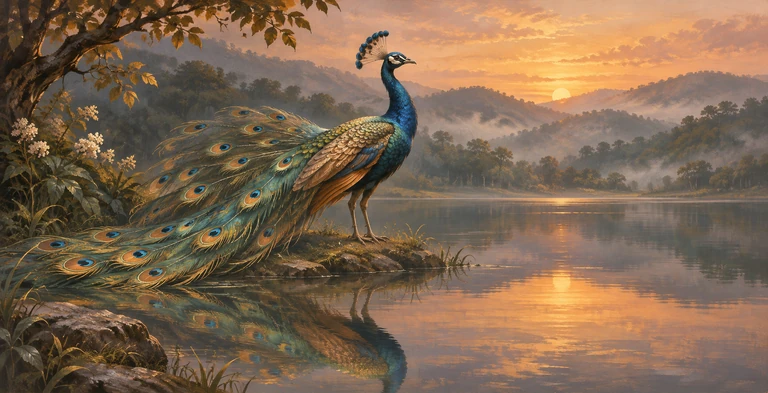
At a golden lake, a prince encounters a woman from a world in which beauty, flight and the possibility of transformation belong to the same story.
On this page
Beside the golden lake
In the narrative known as Zhao Shutun and Nanmunuona, a prince meets the peacock princess. They fall in love and marry, but royal intrigue and war bring separation.
The princess returns to her own realm, and the prince must travel through hardship to find her again. Many tellings culminate in reunion, celebrating perseverance and attachment to home.
The feathered garment
In some regional forms of the story, the prince obtains or conceals a feathered garment, preventing the princess from flying away. This episode complicates the romance, raising questions about choice, power and gender that a modern reader need not ignore.
Other passages emphasise the princess's dignity and fortitude. Folklore can be admired while also being read with curiosity about the values of its various tellers.
A poem in many forms
The national intangible cultural heritage record describes a long poem preserved through recitation in the Tai Lue language, written transmission and prose storytelling. Artists also used episodes as subjects in Buddhist temple murals and related paintings.
The Peacock Princess is thus more than a single manuscript. Its cultural life has included song, performance, language and visual art.
Across cultures, distinct in expression
Related Suthon–Manora stories are known elsewhere in mainland Southeast Asia, including Thailand. Shared narrative motifs reveal connections, but they do not make every regional version identical.
Names, episodes, dramatic emphasis and musical traditions vary. The Xishuangbanna telling deserves attention in its own language and cultural setting.
The voices that remain
In 2008, China listed Zhao Shutun and Nanmunuona in its national intangible cultural heritage register. The record also observes that relatively few performers are able to recite the complete traditional long poem.
Preservation therefore means more than protecting a written story: it also means sustaining the voices, knowledge and performances that give that story life.
Sometimes cultural memory survives not in an object, but in the act of telling.
The Peacock Princess continues to speak across generations. Its enduring beauty lies not only in the characters, but in the people who refuse to let its words disappear.
Research notes
Selected sources for the historical or cultural context discussed above. Source links are not individual object authentications.
Curatorial note. An English editorial retelling and historical overview, not a translation of one complete manuscript. The golden lake in this tale is not proven to be the same place as the lake in the separate Golden Deer story.